Type “korean writing system explained” into Google and you’ll get a wall of alphabet charts: 14 consonants, 10 vowels, done. That’s true, but it’s also the easy 10% of the story. The part almost nobody explains is why you can memorize every letter in an afternoon and still stare blankly at a Seoul subway sign or a ramyun package three weeks into your trip. This article covers the alphabet basics quickly, then spends most of its time on the three invisible layers — pronunciation shifts, romanization chaos, and the hanja hiding underneath — that actually determine whether Hangul clicks for you.
What Do People Actually Mean by “The Korean Writing System”?
When people say “Korean writing system,” they almost always mean Hangul (한글) — the native script created for Korean. But here’s a detail most beginner guides skip entirely: modern Korean text isn’t purely Hangul from top to bottom. Walk past a Buddhist temple and the gate plaque might read something like 大雄殿 instead of the Hangul spelling 대웅전. Pick up a broadsheet newspaper and you’ll still spot a stray hanja character dropped into a headline to save space or disambiguate a name. Older law offices and some traditional restaurants keep hanja on their signboards for the same reason a Western bakery might use a fancy script font — it signals heritage. Everyday signage, menus, subway announcements, and K-pop lyrics are essentially all-Hangul now, so as a traveler you can function without ever learning a single hanja character. Just don’t be thrown when you spot a cluster of dense characters on an old shopfront — that’s not Hangul breaking down; it’s a separate, older layer of Korean writing that Hangul was invented to replace for everyday use.
Why Can You “Read” Hangul in an Afternoon but Still Not Understand a Menu?
Hangul was deliberately engineered to be learnable fast. King Sejong the Great commissioned it, and it was promulgated in 1446 under the name Hunminjeongeum — a script built specifically so ordinary people, not just the aristocracy who could afford years of hanja study, could become literate quickly. The old saying still gets quoted today: “a wise man can learn it in a morning, a fool in ten days.” Most visitors who sit down and actually drill the 24 basic letters can sound out real signs within a couple of focused hours. That’s not marketing copy — it’s the entire point of the design.
But “sounding out” and “understanding” are two different skills, and this is the gap almost every quick-start guide glosses over:
- Vocabulary is still vocabulary. Reading 사과 as “sa-gwa” doesn’t help unless you already know it means apple.
- Pronunciation shifts when letters combine. Korean has sound-change rules where a final consonant (batchim) morphs depending on what follows it. The instant noodle brand 신라면 is a perfect real-world example: read letter by letter it looks like it should be “sin-la-myeon,” but the ㄴ and ㄹ collide and soften it into “sil-la-myeon” out loud — the same shift that turns the ancient kingdom 신라 into “Silla.” This is exactly why tourists who’ve memorized the chart still can’t match what they hear at a convenience store to what’s printed on the wrapper.
- Spacing and word boundaries take practice. Korean sentences use spaces between words, but figuring out where one word block ends and a grammar particle begins is a separate skill from reading individual syllable blocks.
None of this makes Hangul hard in the way a script with thousands of characters is hard. It just means “I can read Hangul” and “I can read Korean” are different milestones, and most explainers blur them together.
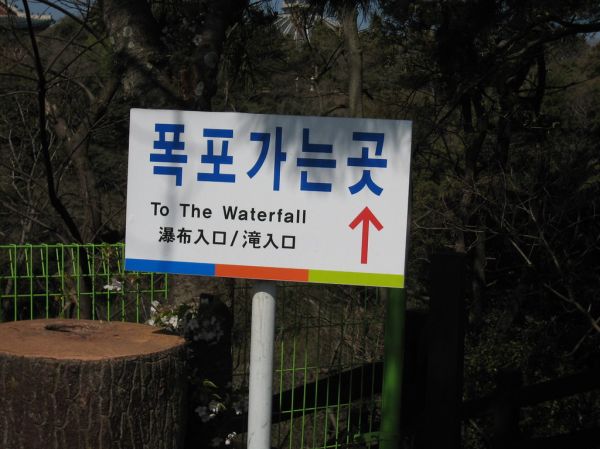
How Are Hangul Letters Organized Into Blocks — the Short Version
Unlike English, where letters run left to right in a line, Hangul groups letters into square syllable blocks. Take 한 (as in Hangul itself): it’s built from ㅎ + ㅏ + ㄴ, stacked into one block that reads as “han.” Or look at 김치 — the first block stacks ㄱ and ㅣ and ㅁ, the second stacks ㅊ and ㅣ, and together they read “gim-chi.” Every block needs at least a consonant and a vowel, and it can optionally end with a final consonant sound called batchim — that’s the ㄴ closing out 한, or the ㅁ closing out the first block of 김치. This block logic is the single biggest visual habit-change for anyone coming from an alphabet that runs in a straight line, and it’s genuinely worth a dedicated study session on its own. For this article, the key takeaway is simpler: once you can recognize that a block is just letters stacked in a fixed order (top-left, top-right or straight down, then bottom), you can start sounding out almost any sign in the country — even ones for words you’ve never heard before.
Why Does the Same Word Look Different in Romanization Around Seoul?
Here’s a frustration that trips up first-timers and rarely gets addressed in “how does Hangul work” articles: the English-letter spelling of Korean words on maps, signs, and older buildings is often inconsistent. Korea has switched romanization systems more than once — the current official one is Revised Romanization, but older maps, some legacy business names, and academic texts still use the earlier McCune-Reischauer system. In practice this means:
- A palace gate might appear as “Gwanghwamun” on a current tourist map and “Kwanghwamun” on an older plaque or in older English-language books.
- The country’s main airport is spelled “Incheon” today, but you’ll still find “Inchon” scattered across older travel writing and outdated business names.
- Family names get spelled inconsistently on business cards or storefronts — the surname 이 shows up as both “Lee” and “Yi” depending on personal preference, not a strict rule.
- Subway station names look slightly different across apps, physical signage, and printed guidebooks, because different sources adopted different systems at different times.
The trade-off to understand: Revised Romanization is more phonetically consistent and is what current government signage uses, so when in doubt, trust what’s printed on the newest-looking sign or an app like the official subway map over an old paperback guidebook. If you’re trying to match a spoken place name to written English letters, a current transit app will get you there faster than a phrasebook printed a decade ago.

Where Can You See the Actual Story of Hangul in Person?
If the history angle interests you more than the grammar angle, the National Hangul Museum in Seoul is built exactly for that — it sits right next to the National Museum of Korea in the Yongsan area, near Ichon Station, and it walks through the script’s invention, the philosophy behind its shapes (the consonants are modeled on the shape your mouth and tongue make to produce each sound, which is a big part of why it’s so learnable), and how it survived periods when its use was actively suppressed. It’s a genuinely good rainy-day stop if you’re already visiting the National Museum of Korea next door, and it turns the alphabet from an abstract chart into something you can actually see being invented, piece by piece.
Also worth knowing if you’re planning a trip: Korea observes Hangul Day (한글날) on October 9 every year, a public holiday specifically commemorating the alphabet’s creation. Government offices, banks, and some smaller shops close, so if your itinerary lands on that date, plan errands and paperwork-heavy tasks — arranging a phone SIM, sorting out bank-related admin — around it rather than on the day itself.
How Should You Actually Start Learning It This Week?
If you’re leaving for Korea soon and want the writing system to actually be useful rather than decorative knowledge, here’s a sequence that works better than just staring at a full chart:
- Learn the 10 basic vowels first. They’re simple lines and dots, and once you know them, half of every block already makes sense.
- Add the 14 basic consonants next, practicing by writing your own name or simple words rather than passively reading a chart.
- Practice on real subway station names before you land — try sounding out “홍대” or “명동” on a transit map and checking it against the English spelling right next to it for instant feedback.
- Learn the common batchim sound shifts only after the basics feel automatic — trying to memorize pronunciation rules alongside the alphabet itself is what overwhelms most beginners.
- Layer vocabulary on top, starting with food and directions rather than grammar textbooks, since that’s what you’ll actually need to read out loud in the first week.
A dedicated app or a one-off lesson works better than a phrasebook for this, simply because you need to hear the sound shifts, not just see them written down. A phrasebook earns its keep later, once you can already read, for building vocabulary fast without needing audio.
자주 묻는 질문 (FAQ)
Is the Korean writing system an alphabet or something else?
It’s most accurately described as a featural alphabet: individual letters represent individual sounds like in English, but those letters are then grouped into square syllable blocks rather than written in a straight line. So it behaves like an alphabet in logic but looks like a syllabary at a glance.
How long does it actually take to learn to read Hangul?
Most visitors can learn to sound out basic Hangul in a couple of hours of focused study, since it was intentionally designed to be simple and phonetic. Understanding what you’re reading takes longer, since that requires vocabulary, not just letter recognition.
Do I need to learn Chinese characters (hanja) to read signs in Korea?
No. Everyday Korean writing — menus, subway signs, storefronts — is essentially all Hangul now. Hanja mostly survives on some older buildings, temple signage, and formal or academic text, and you can travel comfortably without knowing any of it.
Why do Korean place names sometimes have different English spellings?
Korea has used more than one official romanization system over the decades. Current signage generally follows Revised Romanization, but older maps, guidebooks, and some business names still reflect the earlier McCune-Reischauer system, which is why spellings can look inconsistent.
Who invented Hangul and when?
King Sejong the Great commissioned the script, and it was promulgated in 1446 under the name Hunminjeongeum, with the design completed a few years earlier. It’s one of the few writing systems in the world with a documented inventor and creation date, which Korea celebrates annually on Hangul Day, October 9.