Most ‘pension refund’ guides for Korea stop at a nationality checklist and call it done. What they skip is the part that actually trips people up: getting your 반환일시금 (Lump-Sum Refund) sent to a bank account outside Korea requires its own separate paperwork, filed on top of the standard application — and it has to happen before you board your flight, not after. We’ve seen people land back home, check their account two weeks later, and find nothing there because one extra form never got submitted. This guide walks through the actual NPS process, the documents for both domestic and overseas transfer, and where people lose weeks waiting on money that should have taken a fraction of that time.
What Most Guides Get Wrong About the Pension Refund
Search this topic and you’ll get a dozen articles listing which passports qualify for a refund, then almost nothing about what happens after you’re approved. That’s backwards. Eligibility is usually the easy part to confirm with one phone call. The part that actually delays people — sometimes by months, not days — is the bank transfer itself, specifically when the money needs to land in a bank outside Korea rather than one still sitting in Seoul or Busan.
The refund is officially called the 반환일시금, administered entirely by the National Pension Service (국민연금공단, NPS). It returns the contributions you paid into the national pension system while legally employed or insured in Korea, provided you don’t qualify for an ongoing Korean pension and you’re leaving the country for good. Before you build any travel or moving budget around this money, call NPS at 1355 and confirm your situation directly. A blog post can’t see your visa history or your country’s actual treaty status — a five-minute call can save you a wasted trip to a branch counter with the wrong paperwork in hand.
Who Actually Qualifies for the Lump-Sum Refund?
Eligibility doesn’t run through nationality alone — it runs through three separate legal doors, and most guides collapse these into one confusing list that leaves people assuming they don’t qualify when they actually do. Here’s how it really breaks down:
- Visa-based eligibility: If you held an E-8, E-9, or H-2 visa while contributing to NPS, you qualify for the lump-sum refund regardless of your nationality. This is the door most guides forget to mention, because they’re too busy scanning passport lists to notice visa history matters just as much.
- Bilateral social security agreement countries: Citizens of a sizable group of countries with a social security agreement with Korea — including the United States, Germany, Canada, the Philippines, India, and Argentina — qualify by treaty. The exact terms vary slightly country to country, which is exactly why a phone confirmation beats assuming your country’s rules match your neighbor’s.
- Reciprocity countries: Citizens of a separate group of countries that extend similar pension rights to Korean nationals living there — Thailand, Indonesia, Malaysia, Sri Lanka, and others — qualify on reciprocity grounds, even without a formal bilateral agreement.
If your nationality doesn’t appear on either list but you worked under an E-8, E-9, or H-2 visa at any point, don’t assume you’re out of luck — that visa history alone can qualify you. This is exactly the kind of detail that gets buried in generic nationality tables, and it’s worth raising directly, by name, when you call NPS.

What Documents Do You Need Before You Leave Korea?
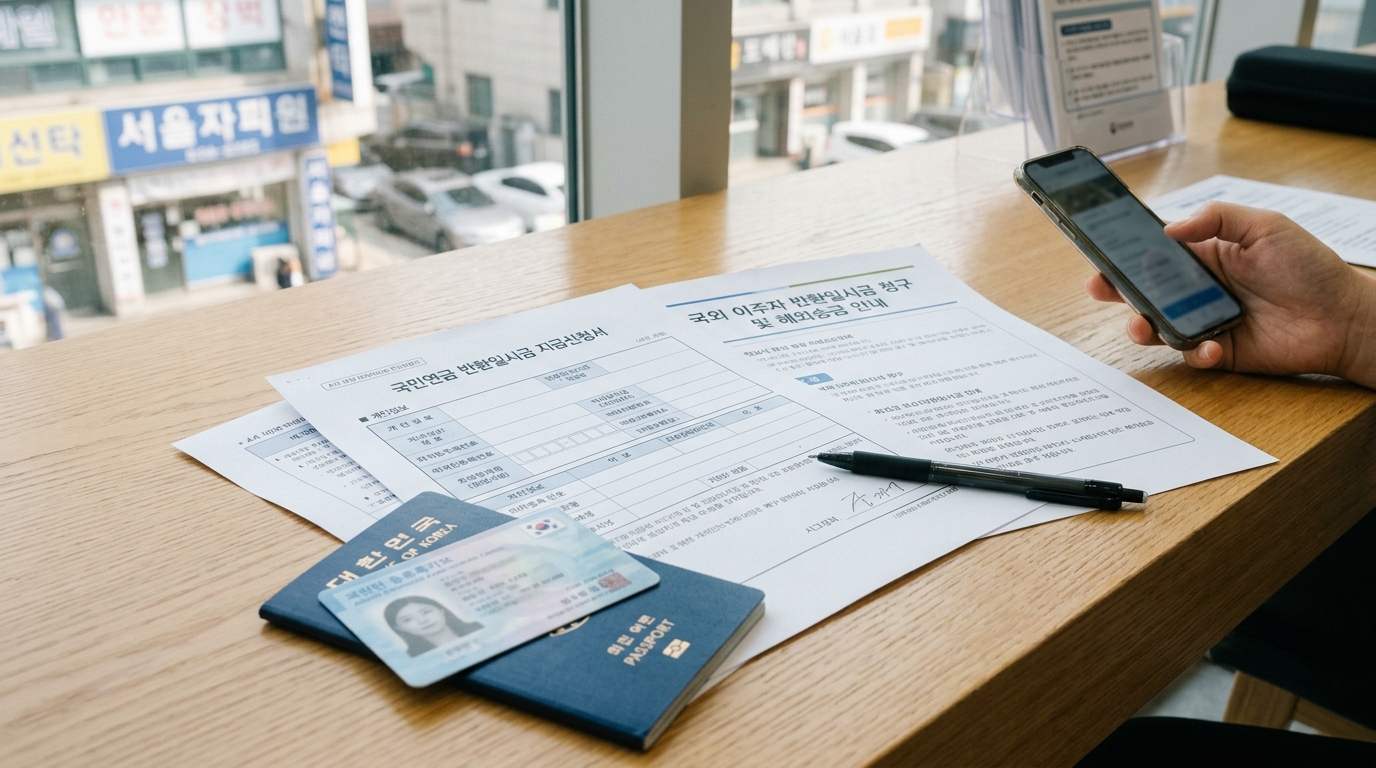
For the standard application, NPS asks for a fairly short packet, but each piece has to be exact — a missing copy or a mismatched date is the most common reason people get sent back to redo the entire visit. You’ll need:
- The completed application for Lump-Sum Refund (반환일시금 지급청구서), officially Form 23 under the Enforcement Rule of the National Pension Act.
- Your passport.
- Your Alien Registration Card (ARC) — bring the physical card itself, not a photo of it on your phone.
- A copy of proof of your bank account (a bank statement or the front page of your bankbook showing the account number and your name clearly printed).
You can file this at an NPS branch before you leave, and in practice a lot of people handle it at the airport NPS counter right before heading through departures, since the timing of your actual exit from Korea matters for processing. Bring originals, not just photocopies — branch staff will usually want to lay the real ARC and passport next to the copies you’re submitting, and they’ll hand them straight back once they’ve checked.
The Overseas Bank Transfer Step Everyone Misses
Here’s the part that most ‘how to get your pension refund’ articles bury in a single vague line, if they mention it at all: if you want the money sent to a bank account outside Korea, the standard document packet above isn’t enough on its own. You need to add an application for overseas remittance, and your foreign bank account details need to be documented clearly enough for NPS and its partner bank to route an international transfer correctly — bank name, SWIFT or routing details where applicable, account holder name matching your passport exactly, and the account number, at minimum.
This is where a lot of refund requests quietly stall. Someone submits the standard form, assumes it automatically covers their foreign account too, and finds out weeks later — often only after emailing NPS to ask where the money is — that the transfer never went out because the extra remittance paperwork was never filed. If you already know you’re keeping the money overseas rather than parking it in a Korean account first, ask the NPS officer specifically for the overseas remittance application at the same visit. Don’t wait for them to bring it up on their own, and don’t assume a Korean bank statement somehow covers a foreign account by default — it doesn’t.
One more detail that catches people off guard: the name on your receiving bank account has to match your passport name, exactly. If your foreign account is registered under a slightly different spelling, a maiden name, a nickname, or shared with a spouse as a joint account, sort that out before you file. It’s a quick fix before submission and a genuinely frustrating one to untangle after a transfer has already bounced.
Step-by-Step: How to Apply for Your Pension Refund
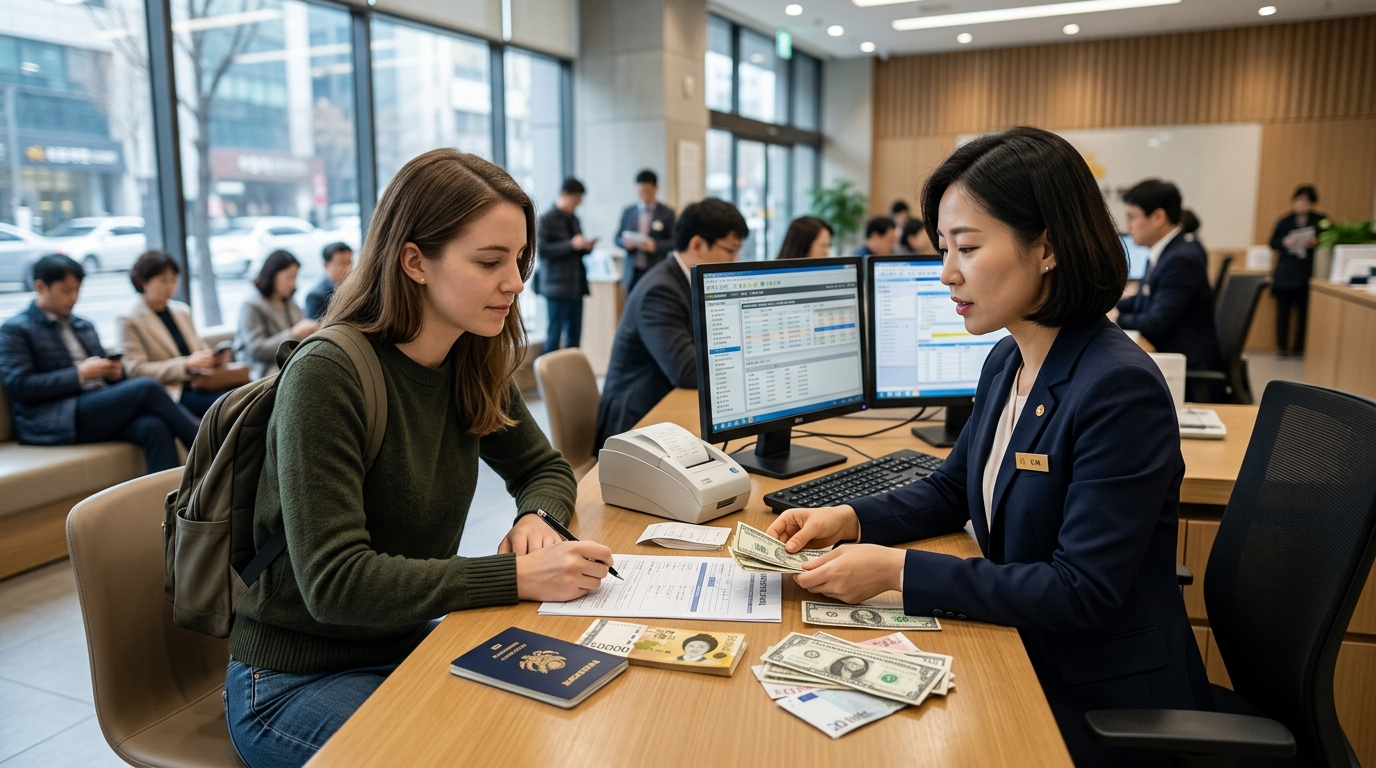
Here’s the realistic order of operations, assuming you’re planning your departure in advance rather than scrambling the night before a flight:
- Call NPS at 1355 to confirm your eligibility based on your actual visa history and nationality, and ask what your specific contribution record shows.
- Decide where you want the money to land — a Korean bank account you’ll keep open a little longer, or your home-country account.
- Gather your documents: application form, passport, ARC, and bank account proof — plus the overseas remittance application if you’re sending money abroad.
- Visit an NPS branch (or the NPS counter inside Incheon International Airport) before your departure, or as close to it as your schedule allows, and submit everything in person.
- Complete your departure from Korea — the refund is tied to you actually leaving, not just filing the paperwork.
- Wait for processing. Domestic transfers tend to move noticeably faster; overseas transfers take longer because of extra verification steps and currency conversion on the receiving end.
- Check your account once funds arrive, and compare the amount against what you expected, since withholding tax and the exchange rate used will both shave something off the final figure.
If you’ve already left Korea without filing, you can still apply from abroad, but expect slower back-and-forth by mail or email to verify documents that would have taken five minutes at a branch counter in person.
Korean Account vs Foreign Bank Transfer: Which Should You Choose?
This is the real decision point, and it’s worth thinking through before you file anything rather than defaulting to whichever account feels more convenient in the moment.
| Option | Paperwork | Speed | Trade-off |
|---|---|---|---|
| Korean bank account | Standard packet only | Generally faster | You need to keep the account open after leaving, and some banks will flag or close accounts that show no local address or activity after you depart. |
| Foreign bank account | Standard packet + overseas remittance application | Slower, more verification steps | Currency conversion and intermediary bank fees eat into the total, but you avoid babysitting a dormant Korean account from another country. |
If you’re planning to visit Korea again soon, or you’ve got a Korean account you’re not in a rush to close anyway, letting the refund land there first and transferring it yourself later can actually be simpler than going through the overseas remittance paperwork. If you’re closing everything out for good — no return trip planned, no reason to keep a Korean number or address active — it’s worth filling out the extra form once rather than trying to keep an account alive remotely for months.

Common Mistakes That Delay or Kill Your Refund
Most of the delays people run into are entirely avoidable once you know what to look for:
- Assuming nationality alone decides eligibility. People whose passports sit outside the treaty and reciprocity lists sometimes don’t realize their E-8, E-9, or H-2 visa history still qualifies them on its own.
- Filing the standard form only, when they actually need the overseas remittance application too. This single missing form is the most common reason a transfer to a foreign account quietly goes nowhere.
- Mismatched account names. A foreign account under a different name spelling, a nickname, or a joint holder than what’s printed in your passport can stall or outright reject the transfer.
- Closing the Korean bank account too early if you’re expecting the refund there, or letting it slide into dormancy before the transfer actually completes.
- Not accounting for withholding tax. The lump-sum refund is subject to a refund income tax depending on your country’s treaty status, so the number that lands in your account won’t always match your total contributions exactly — don’t be alarmed if it’s a bit lower than you calculated.
- Assuming same-day or next-day processing. Bank transfers, especially overseas ones, pass through several verification checkpoints on both the Korean and receiving bank’s side — build in buffer time rather than planning around a specific date.
What to Check Before You Start the Process
Before you walk into an NPS branch or dial 1355, a little prep work saves you an entire extra visit later:
- Confirm your total contribution period through NPS directly — this affects both your eligibility and the final refund amount, and it’s not something a generic calculator online can get right for your specific case.
- Check your ARC validity and departure timeline, since the refund process is tied to your actual exit from Korea, not just the date you submit your application.
- Decide on your bank account strategy — domestic or overseas — before you show up, so you know exactly which documents to bring and don’t have to make a second trip.
- Verify your name matches exactly across your passport, ARC, and the receiving bank account if you’re sending money abroad.
- Keep copies of everything — your ARC becomes invalid the moment you leave, so a clear photocopy or scan on your phone can help resolve any follow-up questions from abroad without needing the physical card again.
None of this is complicated on its own. The problem is that it’s scattered — a form here, a treaty list there, an extra application buried in a footnote somewhere else. Walking in with all of it sorted out in advance is what actually separates a refund that lands in a few weeks from one that drags on for months of email chains.
자주 묻는 질문 (FAQ)
Can I apply for the pension refund after I’ve already left Korea?
Yes, you can still file from abroad, but it typically takes longer because document verification happens by mail or email instead of in person. Filing before departure, either at an NPS branch or the airport NPS counter, is faster and avoids most of that back-and-forth.
How long does the bank transfer actually take?
It varies by case, but domestic Korean bank transfers generally move faster than overseas ones, which involve extra verification and currency conversion. Build in a reasonable buffer, especially for international transfers, since extra documentation requests can add to the wait.
Is tax deducted from the lump-sum refund?
Yes, a refund income tax is typically withheld, and the exact treatment can depend on whether your country has a tax treaty with Korea. Ask NPS or a tax office about your specific situation rather than assuming the full contribution amount will arrive untouched.
What if my country isn’t on the treaty or reciprocity list?
Check your visa history first — E-8, E-9, and H-2 visa holders qualify for the lump-sum refund regardless of nationality. If neither that nor a treaty or reciprocity agreement applies to you, call NPS at 1355 to confirm your specific case before assuming you’re ineligible.
Do I need extra paperwork to send the refund to my home country bank account?
Yes. On top of the standard application, passport, ARC, and bank proof, you need to submit an additional application for overseas remittance. This is the step most guides skip, and missing it is the most common reason transfers to foreign accounts stall.