Short answer: what makes Seoul unique has less to do with any single palace, market, or tower, and everything to do with how tightly packed those things are — and how little effort it takes to string them together. Most guides hand you a checklist: palace, market, nightlife district, viewpoint, each with its own paragraph and its own imagined day trip. The more useful way to think about it is this: Seoul lets you walk through a 14th-century royal courtyard before lunch, wander a hillside village of tiled-roof houses right after, and watch that same skyline light up from a mountaintop by dinner — all connected by a subway fare that costs less than the coffee you’ll grab along the way.
What do most guides get wrong about Seoul’s uniqueness?
They write about Seoul the way you’d write about a museum with separate rooms: Gyeongbokgung gets one section, Myeongdong shopping gets another, Hongdae nightlife gets a third — as if each one needed its own day, or even its own trip. That logic holds up fine for a city like Tokyo or Beijing, where the historic core, the main shopping strip, and the nightlife district can sit an hour or more apart by train.
Seoul breaks that pattern. The palace district, the old hanok neighborhoods, the big shopping strips, and the university nightlife zones all sit within a short subway hop of each other — often close enough that you’ll spend more time picking a restaurant than actually getting there. That physical compression is the real answer to “what makes Seoul unique,” and it’s strange how rarely a guide says so outright. Most just list the places side by side and let you stumble onto the proximity yourself, usually mid-trip, T-money card already in hand, wondering why nobody mentioned this sooner.
Can you really see 600-year-old Seoul and 2020s Seoul in one afternoon?
Yes — and doing exactly that might be the fastest way to understand the city, faster than reading a stack of guides about it. A realistic sequence looks something like this:
- Morning: Gyeongbokgung Palace (Jongno-gu, right next to Gyeongbokgung Station on Line 3) — the main royal palace of the Joseon dynasty, with sweeping courtyards, mountain views behind the throne hall, and a changing-of-the-guard ceremony out front if your timing lines up.
- Late morning: a 10–15 minute walk into Bukchon Hanok Village, a hillside neighborhood of traditional wooden houses where people still actually live.
- Afternoon: a short subway hop to Myeongdong for skincare shops and street snacks, or further out to Hongdae for the busking-and-indie-café scene near Hongik University.
- Evening: Namsan Mountain and N Seoul Tower, for a sunset that slowly turns into a lit-up city skyline.
No other major Asian capital lets you stack a royal palace, a lived-in historic district, a retail district, and a mountaintop skyline into one day without a car, a tour bus, or a spreadsheet of a plan. In Seoul, that’s just a Tuesday.

What makes Gyeongbokgung Palace worth the detour, not just a photo stop?
Entry costs only a few thousand won — roughly the price of one subway ride — but here’s the part most first-timers miss until someone tells them: admission is free if you’re wearing a rented hanbok, the traditional Korean dress. Rental shops cluster thick around the palace gates, charging somewhere in the range of 15,000 to 30,000 KRW for a few hours, which sounds like a tourist upsell until you realize it also waives your entry fee and gets you noticeably better photos against the wooden halls and the mountain ridge behind them.
If you’re planning to hit more than one palace — Gyeongbokgung, Changdeokgung with its Secret Garden, Changgyeonggung, Deoksugung, and Jongmyo Shrine — don’t buy tickets one at a time. A combined pass covering all five is available and can be a convenient option if you plan to visit multiple sites, though it isn’t always cheaper than buying tickets individually, so it’s worth checking current pricing before assuming it’s a bargain.
Why does Bukchon Hanok Village feel different from other “old town” attractions?
Because nobody built it for you. It isn’t a reconstruction, and it isn’t a preserved-for-tourists diorama — it’s a functioning neighborhood where the hanok houses between Gyeongbokgung and Changdeokgung are privately owned, and plenty of them are still lived in. That’s exactly why timing matters: aim for before 9 or 10am, both to beat the tour groups posing at the prettiest alleys and out of basic courtesy toward residents trying to leave for work while a crowd photographs their front gate.
The contrast this neighborhood sets up is really the whole point of visiting. Walk ten minutes downhill and you’re back among convenience stores, traffic lights, and delivery scooters. Nowhere else in Seoul does the jump between eras happen quite this abruptly — one street of curved tile roofs, the next of espresso machines.

How does the subway make all this contrast possible?
Pick up a T-money card at any CU or GS25 convenience store, or from a machine at the station — the card itself costs a small flat fee, and then you load cash onto it as you go. A basic ride runs around 1,400–1,500 KRW, and transferring between bus and subway comes with a discount rather than a fresh fare each time. One card covers everything: the palace turnstile, the market snack stall, the cable car queue, the convenience store run afterward.
The one trade-off worth knowing before you plan a late night: the subway generally stops running somewhere around midnight to 1am and doesn’t start again until roughly 5:30am. If your evening runs past that window — easy to do in Hongdae or Gangnam — you’re looking at a taxi or one of the night buses marked with an “N” prefix. The visitors who end up stranded outside a locked station at 1am are almost always the ones who never checked the last-train time in the first place.
Myeongdong, Hongdae, or Gangnam — which contrast should you chase?
This is where Seoul’s compression trick shows up again: three neighborhoods with almost opposite personalities, each one reachable from the others in well under half an hour by subway.
- Myeongdong — wall-to-wall skincare shops, street snack carts, and department stores. Good for daytime wandering and gift shopping, though it can feel more transactional than atmospheric, especially once you’ve passed the fifth identical sheet-mask display.
- Hongdae (around Hongik University) — younger, louder, built around indie music, street busking, and food that keeps serving well past midnight. Best after dark on a weekend, when the sidewalks turn into an unofficial stage.
- Gangnam — glossy, modern, full of upscale cafés and glass high-rises. This is the Seoul you’ve seen in K-dramas set in ad agencies and law firms, not the one from historical dramas.
Pick based on your mood and the time of day rather than trying to force all three into one visit — though it says something about the city that you genuinely could, if you wanted to, just by following the subway line.

Where does the street food scene fit into Seoul’s identity?
Gwangjang Market, near Jongno 5-ga Station, might be the clearest single example of old-meets-new-appetite Seoul: a covered traditional market that’s been running for generations, now packed with visitors chasing bindaetteok (crispy mung bean pancakes fried until the edges go lacy and brown) and mayak gimbap, small seaweed rice rolls nicknamed “addictive” because one bite makes it hard to stop at just one. Most plates cost somewhere in the range of a few thousand won, cheap enough to try four or five different stalls in one visit without doing the mental math each time.
The market sits only a few subway stops from Gyeongbokgung, which means a morning spent among palace courtyards can end with lunch at food stalls that have been serving the same dishes for decades — no real detour required. That’s the same pattern showing up again, in a different form: history and daily life, separated by a short ride rather than a planned excursion.
Why is N Seoul Tower the best place to actually see this contrast?
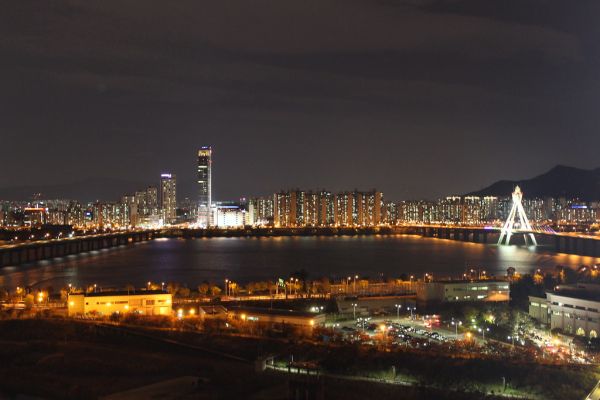
From the observation deck on Namsan Mountain, you can look down and see the exact layering this whole article has been describing: hanok roofs, palace grounds, glass office towers, and the Han River curving through all of it, in one sightline. Ride the cable car up if you want the quick version, or walk the trail if you’d rather let the view build gradually instead of arriving all at once.
Sunset into night is the move here — watching the skyline shift from daylight haze to a grid of lit windows is about as complete a visual answer to “what makes Seoul unique” as you’ll find anywhere in the city. The fences covered in padlocks near the tower (the so-called “love locks”) are worth a glance, but they’re the bonus, not the reason to make the trip.

When should you visit to see Seoul at its best?
Two windows stand out clearly above the rest of the calendar:
- Early-to-mid April — cherry blossoms along the palace walls and riverside paths, with mild enough temperatures to comfortably walk the whole palace-to-hanok-to-tower route on foot.
- Late October into early November — fall foliage, especially rich around the palace grounds and along Namsan’s walking trail, where the color tends to hold a bit longer than elsewhere in the city.
Summer runs hot and humid enough that walking between neighborhoods stops being pleasant and starts being an endurance exercise, and winter turns cold and dry — still workable, but you’ll end up optimizing for indoor stretches like markets, cafés, and department stores rather than the outdoor palace-and-mountain combination that shows the city off at its best.
What’s the one mistake that trips up almost every first-time visitor?
Tipping. It simply isn’t part of Korean dining culture, and leaving extra cash on the table tends to confuse restaurant staff rather than flatter them — on the rare occasion a service charge applies, it’s already folded into the listed price, not added afterward. Visitors arriving from tipping-heavy countries often keep doing it out of habit for the first few meals; you can drop it entirely and put that spare cash toward another round of bindaetteok instead.
자주 묻는 질문 (FAQ)
What makes Seoul unique compared to other big Asian cities?
Mainly the proximity between eras and moods: a centuries-old royal palace, a lived-in hanok neighborhood, glossy shopping districts, and mountaintop skyline views all sit within a short subway ride of each other, letting you move between them in a single day rather than across a whole itinerary.
Is Gyeongbokgung Palace or Bukchon Hanok Village more worth visiting?
They’re best paired, not compared — the palace shows Korea’s royal history at scale, while Bukchon, a short walk away, shows how ordinary people lived and, in many cases, still live today. Doing both back-to-back in the same morning is really the point.
Do I need a tour guide to understand what makes Seoul unique?
Not really. A T-money transit card and a rough plan (palace in the morning, hanok village midday, a shopping district in the afternoon, Namsan at sunset) let you experience the city’s contrasts on your own timeline, without a guided group.
What’s the biggest scheduling mistake visitors make in Seoul?
Underestimating how early the subway shuts down, generally around midnight to 1am with no service until roughly 5:30am. Anyone staying out late in Hongdae or Gangnam should plan for a taxi or an ‘N’ night bus route in advance.
Should I tip at restaurants in Seoul?
No. Tipping isn’t part of Korean dining culture and can confuse staff rather than please them — any service charge is already included in the menu price, so there’s no extra amount expected.