Most “types of kimchi” articles just hand you a numbered list of 20 to 50 names with a one-line translation each, and call it a guide. That’s technically accurate and practically useless — it’s like listing every cheese in France without ever explaining the difference between a fresh chèvre and a blue. The real question a first-timer needs answered isn’t “how many kinds exist,” it’s how are they organized, so you can walk up to a banchan spread in Seoul, or a wall of tubs at a Korean grocery store, and actually know what you’re pointing at. This guide sorts kimchi the way Koreans themselves think about it: by vegetable, by season, by fermentation, and by spice level — including the non-spicy branch that almost every foreign-facing article conveniently forgets to mention.

What Do Most Kimchi Lists Get Wrong?
Two things, consistently. First, they treat kimchi as one dish with variations, when it’s really a category — closer to “pickle” than to any single recipe. Nobody asks “what does pickle taste like” and expects one answer; kimchi deserves the same courtesy. Second, they quietly assume everything on the list is red, spicy, and heavily fermented, which is exactly the impression that scares visitors off before they’ve tried a single bite. In reality, some of the most beloved types of Korean kimchi — dongchimi, baek-kimchi — have no chili in them at all, and taste closer to a chilled pickle brine than to anything fiery. If you’ve been avoiding kimchi because you don’t like heat, odds are you’ve simply never been handed the right jar.
How Are Kimchi Types Actually Organized in Korea?
Instead of memorizing dozens of names, it helps to sort kimchi along four overlapping axes. Almost every variety you’ll run into fits into more than one of these at once:
- Main vegetable — napa cabbage, radish, cucumber, green onion, mustard leaf, chive
- Season — some kimchi is made to be eaten fresh within days; some is made once a year, in bulk, to last through an entire winter
- Fermentation level — from barely-fermented “fresh kimchi” you’d happily eat like a salad, to deeply sour, months-old kimchi that’s really meant for stew
- Spice level — red-chili kimchi versus the white, brothy, non-spicy branch most menus don’t bother translating
Once that grid is in your head, a menu or a grocery aisle full of unfamiliar Korean names stops being intimidating and starts being legible — you can guess what something is before you even taste it.
What’s the Baseline: Baechu-Kimchi?
Baechu-kimchi — whole or quartered napa cabbage seasoned with chili powder (gochugaru), garlic, ginger, fish sauce or salted shrimp (jeotgal), and often a bit of glutinous rice paste to help everything cling — is the kimchi most people picture the moment someone says the word. It’s the default banchan set down at nearly every Korean meal without you asking, and it’s the one at the center of kimjang, the communal kimchi-making tradition families still do together heading into winter, sometimes putting up enough cabbage to fill a spare refrigerator. Nearly everything else on this list is either a variation on baechu-kimchi’s method applied to a different vegetable, or a deliberate departure from it.
Which Kimchi Types Aren’t Spicy at All?
This is the part most guides skip entirely, and it’s the single most useful thing to know if you’re kimchi-curious but chili-averse.
- Dongchimi — whole small radishes fermented in a light, faintly sweet, salty brine with zero chili powder. It tastes less like “kimchi” and more like a refreshing, slightly fizzy pickle-water; it’s traditionally a winter thing, and it’s often what cold buckwheat noodles (naengmyeon) are actually swimming in, since the broth is frequently built on dongchimi liquid rather than plain water.
- Baek-kimchi (“white kimchi”) — made with the same napa cabbage and the same basic technique as regular baechu-kimchi, just with the chili powder left out, so the color stays pale gold instead of red and the flavor comes out milder and a touch sweet. It’s the version often set in front of kids, guests with a low spice tolerance, or served alongside something greasy and rich where you don’t want the heat competing for attention.
- Nabak-kimchi — thin-sliced cabbage and radish sitting in a watery, faintly pink, mildly seasoned brine, eaten more like a cold soup-salad you’d spoon up than a side dish you’d pick at with chopsticks.
If someone tells you “I don’t like kimchi, it’s too spicy,” hand them a bowl of dongchimi instead of arguing. It tends to change minds faster than any explanation.
What Are the Main Radish-Based Kimchi Types?
Radish is the second pillar of Korean kimchi-making, and it splits into a few genuinely distinct forms depending on how it’s cut and how young the radish is when it’s picked:
- Kkakdugi — radish cut into stubby cubes, seasoned red, and left crunchy rather than soft. This is the classic partner for gomtang or seolleongtang (milky beef bone soups), because its snap and acidity slice right through the richness of a broth that would otherwise feel heavy after a few spoonfuls.
- Chonggak-kimchi — made with young “ponytail” radish, left whole with the leafy stems still attached (the name plays on how the young radish, stem and all, resembles an old-fashioned bachelor’s topknot). It’s chewier, earthier, and a bit more of an acquired taste than kkakdugi.
- Yeolmu-kimchi — made from young summer radish greens rather than the root, often tossed into bibim-guksu (spicy mixed noodles) or served on its own as a light, grassy summer side.
If you only remember one distinction: kkakdugi is cubed and shows up everywhere; chonggak-kimchi is whole, stemmed, and slightly more rustic; yeolmu is all leaf, and strictly a warm-weather thing.
What’s the Difference Between Fermented Kimchi and Geotjeori?
This is a trade-off worth actually understanding rather than glossing over with “one’s fresher, one’s older.”
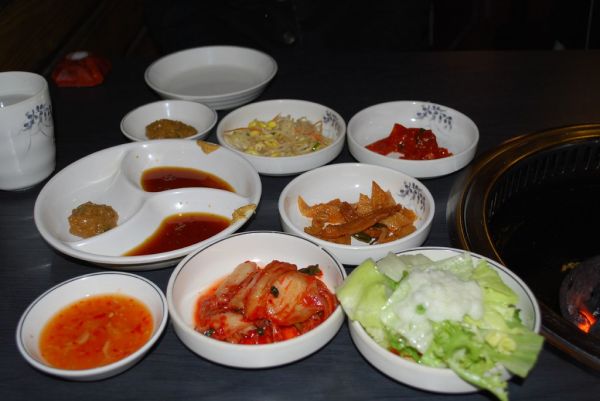
- Geotjeori is “fresh kimchi” — cabbage or other vegetables tossed with the same seasoning as regular kimchi, but meant to be eaten within a day or two, before real fermentation ever kicks in. It’s crisp and bright, closer in texture to a dressed salad than to jarred kimchi, and it’s usually what shows up freshly made at a Korean barbecue restaurant, tossed to order to go with the grill.
- Fully fermented kimchi — the kind aged for weeks or months, sometimes in underground jars or a dedicated kimchi refrigerator that keeps a family’s stash at exactly the right temperature — turns progressively sourer and softer as it sits. Well-aged, properly sour kimchi is actually the preferred choice for cooking: kimchi-jjigae (kimchi stew) and kimchi-bokkeumbap (kimchi fried rice) both taste noticeably better with older, funkier kimchi than with anything fresh out of the bowl.
The practical takeaway: if a dish is a side you’re eating as-is, freshness is usually the prized quality. If a dish is cooked, sourness is an asset, not a flaw. Don’t assume “more fermented” automatically means “better” — it depends entirely on what’s on the plate next to it.
Do Kimchi Types Differ by Region in Korea?
Yes, noticeably enough that kimchi starts to behave less like a single national dish and more like regional cooking, the way you’d expect ragù to change from Bologna to Naples.
- Jeolla-do (the southwestern region around Gwangju and Jeonju) is famous for kimchi loaded with seafood-based jeotgal — salted shrimp, anchovy sauce, sometimes even fermented croaker — which pushes the flavor toward something deeper, funkier, and more savory than kimchi made elsewhere. Jeolla is also home turf for gat-kimchi, made from mustard leaf, especially around Yeosu, with a sharp, peppery bite that lingers.
- Gyeongsang-do (around Busan and Daegu) tends toward saltier, spicier kimchi with less sweetness — fewer seasoning ingredients, but a harder punch from the ones that are there.
- Central regions, including Seoul, generally land in the middle: moderate spice, moderate salt, and this is more or less the “standard” version most restaurants outside Korea model their kimchi on.
- Northern-style traditions (carried south by families with roots in what’s now North Korea, especially the Kaesong area) lean toward less chili and more broth — dongchimi and baek-kimchi both trace back to this milder, more brine-forward lineage.
None of this is trivia for its own sake — it’s the actual reason kimchi at a restaurant in Jeonju can taste like a different food entirely from kimchi at a restaurant in Busan, even though a menu would list both simply as “baechu-kimchi.”
Which Kimchi Should You Actually Try First?
If you’re new to Korean food, here’s a sequencing that actually makes sense, rather than diving straight into the strongest, funkiest jar on day one and deciding kimchi “isn’t for you”:
- Start with geotjeori or fresh baechu-kimchi at a barbecue restaurant — mild fermentation, familiar crunch, the easiest possible entry point.
- Try kkakdugi alongside a bowl of gomtang or seolleongtang — the pairing is designed to work together, so it’s a quick, almost effortless way to understand why kimchi exists as a side dish rather than a standalone snack.
- If you’re chili-averse, ask for dongchimi or baek-kimchi by name — most restaurants serving a traditional set meal (hanjeongsik) keep one of these in rotation, especially once winter hits.
- Save well-aged, very sour kimchi for cooked dishes like kimchi-jjigae rather than eating it straight off a spoon — it’s a completely different experience once it’s simmered into a stew, and it makes far more sense in that context.
The mistake most first-timers make is judging “kimchi” as one thing based on whatever random banchan happened to land on their table first. Given the actual range — from a cold, mild radish brine to a fiery, months-aged cabbage — that’s a bit like judging all of “cheese” after one bite of blue cheese and never touching a mozzarella.
Where Can You Actually Compare Kimchi Types in Korea?
A few practical spots make it easy to taste a real spread side by side, rather than settling for whatever one restaurant happens to serve that day:
- Traditional markets like Gwangjang Market in Seoul often have vendors selling several types of kimchi by weight out of open tubs, so you can compare kkakdugi, baechu-kimchi, and pa-kimchi (green onion kimchi) within a few footsteps of each other.
- Hanjeongsik (full-course) restaurants, especially in Jeonju, tend to bring out several kimchi varieties as part of the banchan spread in a single sitting, which is an easy shortcut to tasting range without seeking out multiple restaurants.
- Museum Kimchikan (formerly the Kimchi Field Museum), now located in Insa-dong rather than COEX, is a low-key but genuinely informative stop if you want the regional and historical context laid out visually before you start eating your way through it — it’s the kind of place that makes the rest of your meals in Korea make more sense.
None of this requires advance planning — it’s the sort of thing you fold into a normal day of eating and sightseeing rather than book as a dedicated “kimchi tour.”
자주 묻는 질문 (FAQ)
How many types of Korean kimchi are there?
Estimates commonly cited range from several dozen to well over a hundred regional and seasonal variations, depending on how finely you want to split hairs. In practice, a handful — baechu-kimchi, kkakdugi, dongchimi, geotjeori, and chonggak-kimchi — cover most of what you’ll actually be served or find on a store shelf.
What is the most common type of kimchi?
Baechu-kimchi (whole or quartered napa cabbage kimchi) is the default — it’s what most people mean when they just say “kimchi,” and it’s what shows up automatically as a side dish at the majority of Korean meals.
Is all Korean kimchi spicy?
No. Dongchimi and baek-kimchi are two well-established, popular types made without any chili at all. They’re brinier and milder, and traditionally eaten in winter or alongside rich, heavy dishes that don’t need extra heat.
What’s the difference between kimchi and geotjeori?
Geotjeori is dressed with the same seasonings as kimchi but eaten fresh, within a day or two, before real fermentation has a chance to develop. Kimchi is left to ferment for much longer, growing sourer and softer as it ages.
Which kimchi should a beginner try first?
Fresh geotjeori or a mildly fermented baechu-kimchi at a barbecue restaurant is the easiest entry point. If you’re sensitive to spice, ask specifically for dongchimi or baek-kimchi — both are widely available, especially in winter.