Short answer: the Korean won (₩) is one of the easier currencies to get comfortable with — there’s no black-market rate to worry about, no confusing string of zeros like the Vietnamese dong, and only a handful of bills to learn. But most guides stop at “here’s the conversion rate” and skip the part that actually affects your wallet: where you change money and how you pay for things determines whether your trip feels reasonably priced or quietly overpriced. This guide gets into the actual logistics — Myeongdong money changers versus airport counters, which ATMs will even recognize your foreign card, and the specific moments when cash beats a Visa in a country that’s otherwise famous for being card-friendly.

What do most guides get wrong about Korean money?
They treat the won like a one-line math problem — “about 1,300 won to the dollar, done” — and move on. That’s technically correct, but it skips the two habits that quietly drain a travel budget: changing cash at the wrong counter (the airport is almost never your best rate, anywhere in the world, and Korea is no exception) and assuming a card will work everywhere (it won’t, and the gaps show up exactly where first-time visitors want to spend — a market stall, a temple donation box, a street cart with a hand-written menu). Understanding the won isn’t really about memorizing the number. It’s about sequencing: knowing when to carry cash, when to tap a card, and when your phone or a T-money card is faster than either.
How much is the won actually worth?
The rate floats with the market, but it’s sat in a fairly narrow band — roughly roughly ₩1,300–1,450 per US$1 (it has drifted higher at times) — for a good stretch, so the fastest mental shortcut while you’re standing at a register is: drop the last three zeros and divide by around 1.3. A ₩13,000 bowl of naengmyeon comes out to roughly US$10. A ₩45,000 dinner for two lands somewhere around US$33–35. It won’t be exact to the cent, but it’s fast enough to run in your head while a cashier at a Gwangjang Market stall or a taxi driver is waiting for you to hand over cash.
Don’t bother memorizing a precise figure before you land — the rate drifts week to week, and any number printed in an article, including this one, will be slightly stale by the time you read it. Check a currency converter app once after you land, then reuse that rough ratio for the whole trip instead of re-checking constantly.

What do won bills and coins actually look like?
Korea keeps its cash lineup short, which genuinely helps when you’re juggling an unfamiliar currency for the first time:
- Bills: ₩1,000, ₩5,000, ₩10,000, and ₩50,000 — that’s the entire set. The ₩50,000 note is the largest bill in circulation, so unlike currencies where you need a rubber band for daily spending money, you’ll rarely be carrying more than a thin fold of notes.
- Coins: ₩10, ₩50, ₩100, and ₩500. The ₩10 coin is worth so little that a lot of long-term expats just toss them in a jar by the door rather than carry them.
One practical habit worth building on day one: the ₩1,000 and ₩5,000 notes sit in a similar green-blue color family, and the ₩10,000 and ₩50,000 can blur together too if you’re moving fast. Glance at the printed numeral in the corner rather than trusting color memory, especially when change is being counted out quickly at a busy stall.
Where should you exchange cash — airport, bank, or Myeongdong?
This is the single biggest lever for how far your money stretches, and it’s the part most articles gloss over in a single sentence.
Incheon Airport counters: convenient, but the worst rate
You’ll walk past exchange booths right after immigration, and they’re perfectly fine for grabbing a small amount to cover your first taxi or airport bus into the city. But the rate posted there is consistently the least favorable you’ll see anywhere in the country — airports everywhere bank on you not wanting to shop around while dragging a suitcase.
Myeongdong’s private money changers: the actual best rate
Seoul’s Myeongdong district has a dense cluster of small, independently run currency exchange shops — look for storefronts with a digital rate board out front, often squeezed between cosmetics shops and street food carts. They typically beat both bank branches and airport counters by a noticeable margin, and they’ll take USD, JPY, EUR, and most major currencies without paperwork or a membership card. You hand over bills, they hand over won, and you’re done in under a minute. If Seoul is even a one- or two-day stop on your trip, it’s worth routing your main cash exchange through here instead of the airport.
Bank branches: safe, but not the sharpest rate
Major banks like Woori, KEB Hana, and Shinhan will also exchange cash, and it’s a reasonable middle option if Myeongdong isn’t on your route. Rates usually land better than the airport but a step behind the private changers.
The practical move: change just enough at Incheon to cover your first taxi ride and a T-money top-up, then do your real exchange once you’re in the city, ideally in Myeongdong.
Cash or card — do you actually need won at all?
Card acceptance in Korea is genuinely impressive by global standards. Visa and Mastercard are taken at nearly every restaurant, café, convenience store, and even most taxis. If your trip is mostly Seoul’s main neighborhoods and chain cafés, you could realistically get through the whole thing without touching a won note.
But there’s a real gap, and it happens to sit right on top of some of the best parts of a Korea trip:
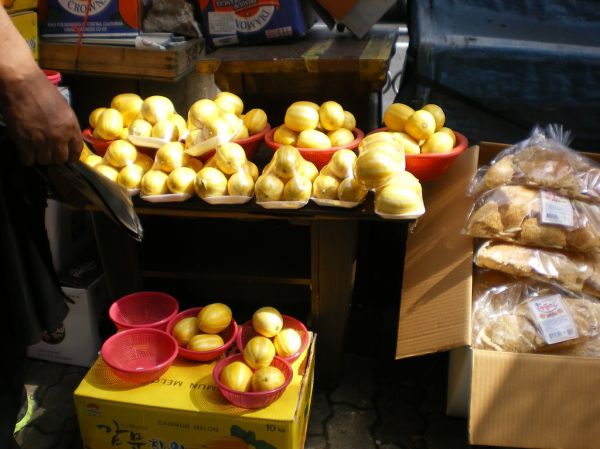
- Traditional markets like Gwangjang Market or Namdaemun — plenty of stalls are cash-only or clearly prefer it, especially on smaller orders.
- Street food carts — the ₩3,000 tteokbokki or hotteok vendor often has no card reader within reach, sometimes no reader at all.
- Temple donation boxes — if a quiet moment at a temple makes you want to leave a small offering, it needs to be cash.
- Small rural guesthouses outside the big cities — a working card machine isn’t a given.
The fix that most seasoned visitors land on after one awkward cashless moment at a market stall: keep roughly ₩20,000–50,000 in cash tucked separately from your card wallet, and default to card for everything else.
Which ATMs actually work with foreign cards?
Not every ATM in Korea will recognize a foreign-issued card, which catches a surprising number of first-time visitors off guard — plenty of ordinary bank machines are set up for domestic cards only. Look specifically for “Global ATM” signage, which you’ll find inside most 7-Eleven and GS25 convenience stores, plus at Woori Bank and KEB Hana Bank branches. These reliably accept Visa, Mastercard, and the Cirrus and Plus networks.
Expect a machine fee somewhere around ₩3,000–5,000 (roughly US$2–4) per withdrawal, stacked on top of whatever foreign transaction fee your home bank charges. Because that fee applies per transaction rather than per amount, it makes more sense to pull out a slightly larger sum less often than to make small withdrawals every day or two. And since the ₩50,000 note is the biggest bill available, even a reasonably large withdrawal still fits in a wallet without turning into an unmanageable brick of cash.

Should you get a T-money card instead of paying cash for transit?
Yes, and it’s one of the easiest small upgrades to your trip. A T-money card costs a few thousand won to buy — sold at convenience stores and subway station machines — and tops up in simple ₩1,000 increments with cash or, at many machines, a card. It works across the subway, city buses, most taxis, and even as payment at a fair number of convenience stores and vending machines, functioning a lot like Hong Kong’s Octopus card or Japan’s Suica if you’ve used either.
Beyond the convenience, it also shaves a small discount off the cash fare each time you tap, and it saves you from fumbling for coins while a bus driver waits. If you’re spending more than a couple of days in Seoul or Busan, picking one up on day one is close to a no-brainer — it quietly becomes the tool you reach for more than either cash or card.
Do you need to tip in Korean won?
No — and this is the habit that trips up visitors coming from the US or other tipping-heavy countries the most. Tipping simply isn’t part of the culture here. Restaurants, cafés, bars, and taxis don’t expect it, and leaving extra cash on the table can genuinely confuse staff or send someone chasing after you to return it, which is its own small culture-shock moment. Your bill is your bill — no tip math layered on top of the exchange-rate math you’re already doing in your head. The one related thing worth knowing: at nicer hotels or table-service restaurants, a service charge is sometimes already folded into the listed price rather than added at the end, so it’s worth glancing at the menu or receipt wording rather than assuming you need to add anything.
What’s the actual first-day money strategy?
Put together, here’s the sequence that sidesteps both the airport rip-off and the cashless-at-the-market scramble:
- At Incheon Airport: exchange a small amount — enough for one taxi or bus ride and a T-money top-up — and hold off on changing your full budget here.
- Buy a T-money card at a convenience store or station kiosk once you’re in the city.
- Head to Myeongdong (or another private exchange cluster) within your first day or two to change your main cash reserve at a noticeably better rate than the airport offered.
- Keep ₩20,000–50,000 in cash on hand at all times for markets, street food, and small vendors.
- Default to card for restaurants, cafés, convenience stores, and most taxis.
- Use a Global ATM (7-Eleven, GS25, Woori, KEB Hana) if you run low, and withdraw a reasonably sized amount so you’re not paying the per-transaction fee too often.
None of this requires actually learning Korean — just recognizing four bill designs and a coin or two. The currency itself is straightforward. It’s the logistics wrapped around it that decide whether your trip’s exchange rate feels fair or feels like a quiet tourist tax.
자주 묻는 질문 (FAQ)
How much is 10,000 won in US dollars?
At a typical rate of around roughly ₩1,300–1,450 per US$1 (it has drifted higher at times), ₩10,000 works out to roughly US$7–8. The exact figure shifts week to week, so it’s worth a quick check on arrival rather than locking in a fixed number before you travel.
Is it better to exchange money at the airport or in the city?
The city wins, pretty consistently. Incheon Airport counters are convenient but tend to offer the weakest rates you’ll find in the country. Private money changers in Myeongdong typically beat both airport and bank rates by a noticeable margin, so it’s worth only exchanging a small amount at the airport and doing your main exchange once you’re in Seoul.
Can I just use my credit card everywhere in Korea?
Almost everywhere, yes — Visa and Mastercard are accepted at the vast majority of restaurants, cafés, taxis, and convenience stores. The exceptions are traditional markets, street food carts, temple donation boxes, and some rural guesthouses, so it’s worth keeping some cash on hand for those specific spots.
Do Korean ATMs accept foreign debit and credit cards?
Not all of them — some ordinary bank ATMs are set up for domestic cards only. Look for machines labeled “Global ATM,” commonly found in 7-Eleven and GS25 convenience stores and at Woori or KEB Hana bank branches. Expect a machine fee of roughly ₩3,000–5,000 per withdrawal on top of whatever fee your own bank charges.
Should I tip in restaurants or taxis in Korea?
No. Tipping isn’t customary in Korea, and offering extra cash can sometimes just confuse staff or get politely turned down. Pay the listed price and move on — no tip math required.