Quick summary: “Tteok” isn’t one food — it’s a whole category, the same way “bread” covers everything from a baguette to a bagel to brioche. Korean rice cakes swing from the chewy street-food cylinders in tteokbokki to delicate steamed cakes brought out at first birthdays and ancestral rites, and a single glass case can hold a dozen types that look nothing alike. This guide sorts the types of Korean rice cake by how they’re made, what they actually taste like, and when Koreans eat them — so the next time you’re standing in front of a tteok shop’s display, you’ll know roughly what you’re looking at instead of just pointing at random.

Why does Korean rice cake come in so many forms?
If your only tteok experience is the chewy cylinders swimming in red sauce, walking into a tteok shop (떡집, tteokjip) for the first time can feel like stepping into a bakery where nothing is labeled — trays of pastel-colored disks, layered cakes cut into diamonds, stuffed dumpling-like balls, dense loaf shapes you could mistake for cornbread. It looks chaotic, but the variation actually comes down to three fairly simple variables: which rice is used, how that rice is processed, and how it’s cooked.
Two base ingredients change almost everything:
- Non-glutinous rice (멥쌀, mepssal) — makes firmer, less sticky tteok, the kind used for tteokbokki or rice cake soup. It holds its shape when boiled, grilled, or simmered for a while, which is exactly why it’s the go-to for savory dishes.
- Glutinous/sweet rice (찹쌀, chapssal) — makes soft, stretchy, almost taffy-like tteok, like injeolmi or chapssaltteok. This is the closer cousin to Japanese mochi, and it tears with your teeth rather than snapping.
On top of that base choice, the rice can be ground into flour and steamed, pounded into dough after steaming, boiled directly, or pan-fried in oil — and each method changes the texture enough that the result barely reads as the same food.
What are the main categories of Korean rice cake by cooking method?
Korean cookbooks usually split tteok into four broad families based on technique. Once these click, you can guess the texture of an unfamiliar tteok just from how it’s described on a menu, even without knowing the name.
1. Steamed rice cake (찐떡, jjin-tteok)
The biggest category by far. Rice flour is steamed in a mold or basket, sometimes layered with sweet beans, nuts, or fruit pressed in. Texture ranges from soft and almost crumbly — think baekseolgi, which falls apart a bit like a dense sponge cake — to firmer and slightly chewy. Songpyeon and most of the rice cakes used for ancestral rites or birthday tables belong here.
2. Pounded rice cake (친떡, chin-tteok)
Steamed rice gets pounded — traditionally with a wooden mallet against a large wooden board, the rhythmic thumping you may have caught on a Korean variety show — until it turns into a smooth, elastic dough that stretches like taffy. Injeolmi and garaetteok (yes, the tteokbokki rice cake) both start this way. The pounding is literally what builds that stretchy chew; skip it, and you just get a lump of steamed flour.
3. Boiled rice cake (삶은떡, salmeun-tteok)
Small balls or pieces of rice dough go straight into boiling water, then usually get rolled in a coating — toasted soybean powder, sesame seeds, sometimes cinnamon sugar. Gyeongdan is the textbook example: bite-sized chewy balls dusted in nutty bean powder, often served at tea gatherings.
4. Pan-fried rice cake (지진떡, jijin-tteok)
Flattened rice dough gets pan-fried in oil, often with edible flower petals pressed on top for looks. Hwajeon (flower rice cake) is the seasonal showpiece — traditionally made in spring with real azalea petals, so it doubles as a dessert and a small act of flower-viewing.
Which types of Korean rice cake will you actually run into as a visitor?
You don’t need to memorize every regional variety — most travelers and expats bump into the same short list on repeat. Here’s what each one actually looks and tastes like, not just what it’s called:
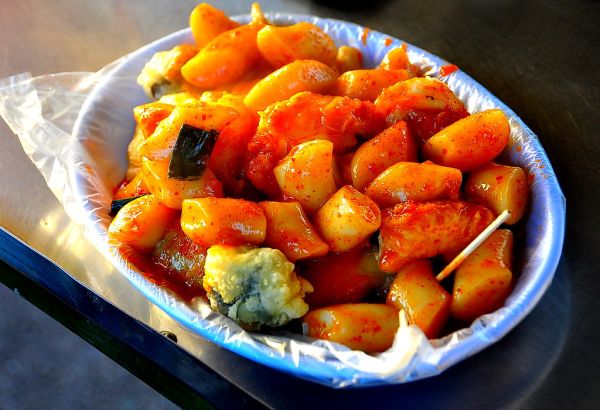
- Garaetteok (가래떡): Plain, cylindrical, chewy white rice cake with almost no flavor of its own. It’s the raw material for both tteokbokki and tteokguk (rice cake soup). Eaten plain, it tastes like very little — all the personality comes from whatever sauce or broth it’s cooked in.
- Tteokbokki rice cake: Technically the same garaetteok, just cut into shorter pieces — but it earns its own entry because it’s most foreigners’ first tteok experience, period. Chewy, faintly springy, neutral until it’s had a few minutes to soak up gochujang sauce.
- Injeolmi (인절미): Soft, stretchy pounded rice cake rolled in roasted soybean powder (콩가루). Mildly nutty, gently sweet, with a texture closer to a very soft caramel chew — a good “gateway” tteok if the idea of sticky rice cakes makes you nervous.
- Songpyeon (송편): Small half-moon rice cakes made for Chuseok, filled with sweetened sesame, chestnut, or bean paste and steamed over pine needles — which is where both the name and a faint, slightly resinous aroma come from.
- Baekseolgi (백설기): Plain white steamed rice cake, soft and a little crumbly, like a very dense, unsweetened sponge cake. It’s traditionally served at a baby’s 100-day celebration (백일) because the plain white color stands for purity and good fortune.
- Chapssaltteok (찹쌀떡): Soft glutinous rice cake stuffed with sweet red bean paste — the closest thing to Japanese daifuku mochi you’ll find in Korea, and often sold individually wrapped at convenience stores for a late-night sugar fix.
- Kkul-tteok: Small rice cakes filled with honey or syrup, a sweet snack sometimes sold as a street-food treat.
- Yaksik (약식): Not strictly a “tteok” by the technical definition, but always shelved right next to them — dark, sticky glutinous rice studded with chestnuts and jujubes and sweetened with honey. Dense, rich, and closer to a dessert bar than a rice cake.
If you’re standing in front of a case unsure where to start, here’s the shortcut locals use without thinking about it: lighter-colored, plain-looking tteok is usually savory or neutral (meant for soup or stir-frying), while tteok with visible fillings, powder coatings, or bright colors is almost always sweet and meant to be eaten straight, no cooking required.
What types of rice cake are tied to specific occasions?
This is where tteok stops being just “food” and starts acting more like a ritual object — which is why the same few types show up again and again at Korean life events, and why an older Korean can often guess what just happened in a family just by glancing at which tteok was passed around.
- New Year’s Day: Tteokguk, rice cake soup made with thinly sliced garaetteok. There’s an old saying that eating a bowl is what actually makes you a year older in the traditional Korean age-counting system — skip the soup, and some people will jokingly tell you you’re still last year’s age.
- Chuseok (harvest festival): Songpyeon, usually shaped together as a family the night before the holiday. Older generations used to say the neatness of your songpyeon predicted a good marriage or a beautiful baby; most families now treat it as a fun bit of folklore rather than anything serious.
- Baby’s 100th day and first birthday (돌잔치): Baekseolgi and colorful layered rice cakes like mujigae-tteok (rainbow rice cake), chosen specifically for what they symbolize — health, purity, a smooth road ahead.
- Moving into a new home: Red bean-coated tteok is traditionally handed out to neighbors, partly as a housewarming gesture and partly as an old superstition meant to ward off bad luck in the new place.
- Ancestral memorial rites (제사): Tall, layered steamed rice cakes stacked in very specific formations on the ritual table — usually plain or only subtly sweetened, since the point is respect, not indulgence.
If a Korean coworker or friend shows up with a box of rice cake out of nowhere, it’s worth asking what the occasion is. Nine times out of ten there’s an actual story behind it — a new baby, a promotion, a move — rather than just “I felt like it.”
How do you actually order or choose rice cake without knowing the names?
Tteok shop signs and market stall labels are almost never in English, and even the Korean terms don’t translate cleanly enough to guess from a dictionary app. Here’s a practical way to navigate one without embarrassing yourself:
- Decide sweet or savory first. Point at something and ask “이거 단 거예요, 매운 거예요?” (“Is this sweet, or spicy?”) — vendors get this question constantly and are usually happy to steer you.
- Read the texture from the color and shine. Glossy, slightly translucent tteok is almost always the chewiest, glutinous-rice type; matte, pale tteok tends to be firmer and milder — a small tell that saves you from a surprise mouthful of stretchy dough when you expected something firm.
- Ask for a small mixed box. Most shops sell assorted boxes (모듬떡) built exactly for indecisive customers — a much better way to find your preference than committing to a full container of one type you might not even like.
- Buy it the day you plan to eat it. Tteok has no preservatives and hardens fast, sometimes noticeably within a single day at room temperature. If it’s a gift or meant for later, ask the vendor whether it needs the fridge or the freezer.
- Revive hardened tteok by steaming it, not microwaving it dry. A quick steam — or a microwave with a damp paper towel draped over the top — brings the chew back; dry microwave heat alone tends to turn it rubbery instead of soft.
Common pitfall: assuming all tteok tastes roughly the same because tteokbokki is so mild. Sweet varieties like injeolmi or chapssaltteok live in a completely different flavor world — closer to a mochi dessert case than to the spicy street-food cart most visitors try first, so don’t judge the whole category on one dish.
How does Korean rice cake compare to Japanese mochi or Chinese nian gao?
This comparison comes up constantly, so it’s worth untangling properly. All three are built on rice and can look similar sitting side by side, but the ingredients and texture pull apart pretty quickly once you taste them:
- Korean tteok leans on non-glutinous rice for its savory forms, which gives a firmer, almost noodle-like bite, and saves the sticky glutinous rice mostly for sweet versions — so the category as a whole covers a much wider texture range than the other two.
- Japanese mochi is nearly always glutinous rice (mochigome), pounded hard and long, which gives it that very uniform, extremely stretchy pull even in savory uses like the mochi floating in zoni soup.
- Chinese nian gao varies a lot by region but tends to be sweeter and denser overall, often steamed as one solid block and sliced to order rather than shaped into individual pieces before cooking.
If you already like mochi and are trying tteok for the first time, injeolmi or chapssaltteok will feel the most familiar under your teeth. If mochi always struck you as too sticky-sweet, garaetteok-based dishes like tteokbokki or tteokguk are a much closer match to a savory, chewy, almost noodle-like bite.
자주 묻는 질문 (FAQ)
What is the most common type of Korean rice cake for beginners to try?
Garaetteok, the rice cake used in tteokbokki, is the easiest starting point — it’s mild, widely sold as street food, and doesn’t ask you to like sweet-and-sticky textures right away. If you’d rather start with dessert-style tteok, injeolmi (the soybean powder-coated one) is a gentler introduction than something fully stuffed and sweet like chapssaltteok.
Is Korean rice cake gluten-free?
Yes — traditional tteok is made from rice flour, not wheat, so it’s naturally gluten-free on its own. The catch is what’s served with it: tteokbokki’s gochujang sauce, for instance, often contains soy sauce or other wheat-derived ingredients, so it’s worth asking if you’re dealing with a strict allergy rather than just a preference.
How long does Korean rice cake last, and can it be frozen?
Fresh tteok has no preservatives, so it hardens fast at room temperature — often within a day. It freezes surprisingly well, though, holding up for a good stretch of weeks to a couple of months. Just steam it or microwave it with a splash of water or a damp towel over the top after thawing to bring the chewy texture back.
What’s the difference between tteok used for soup and tteok used for tteokbokki?
Most of the time it’s the exact same garaetteok, just cut differently — thin diagonal ovals for tteokguk (rice cake soup) and short, thick cylinders for tteokbokki. Some shops even sell it pre-cut and labeled for each dish, so you don’t have to slice it yourself.
Are there savory types of Korean rice cake beyond tteokbokki?
Definitely. Beyond soup and stir-fried versions, tteok shows up in dishes like tteok-galbi (rice cake worked into grilled short rib patties) and grilled tteok skewers brushed with a soy-based glaze rather than gochujang — a good option if you want the chew without the heat most visitors associate with the dish.